Introduction
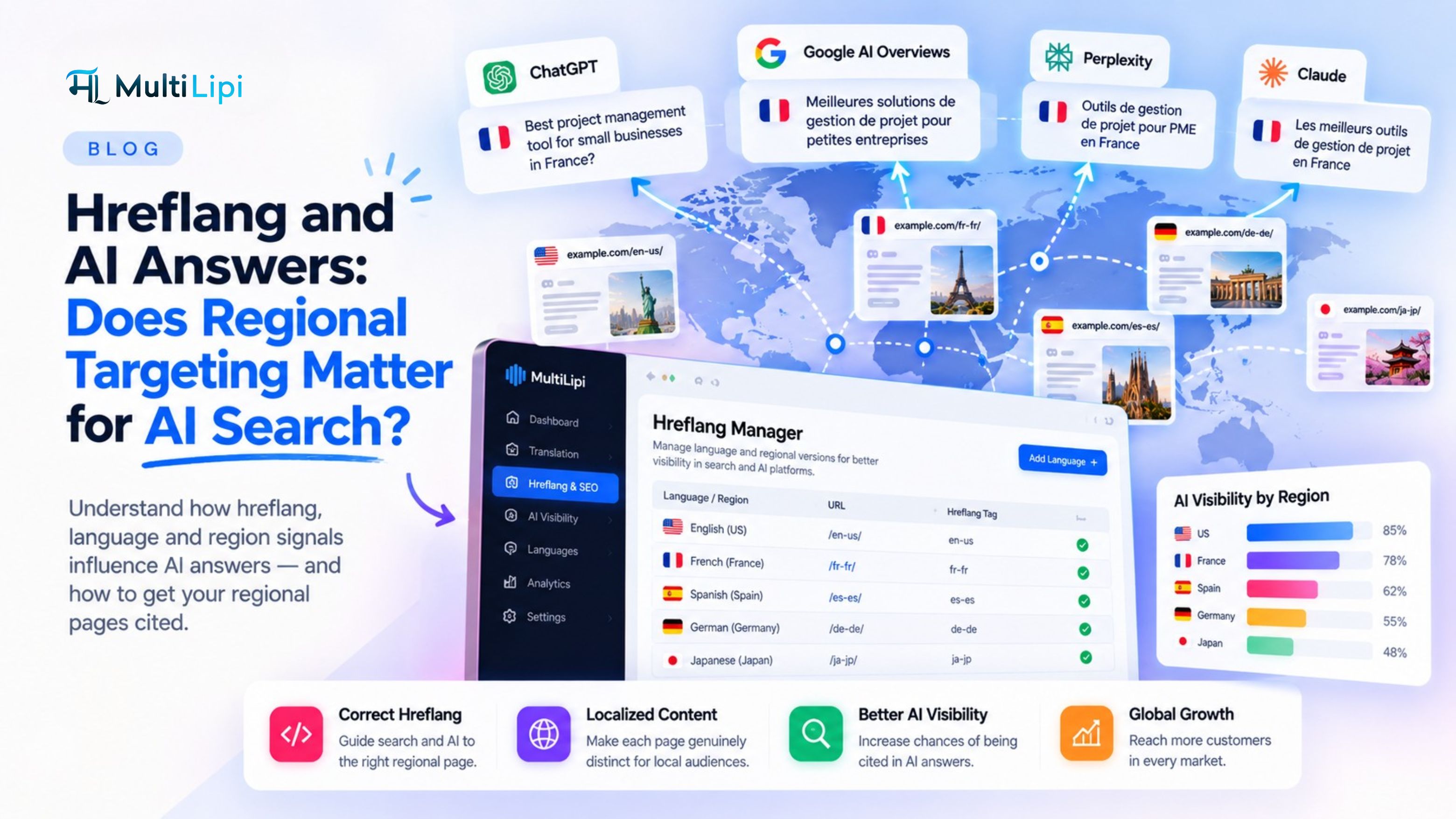
When someone asks an AI assistant a question, which version of your page does it cite? If you publish for several markets, that choice decides who sees your brand and whether they land on the page built for them. Auditing hreflang implementation with large-scale crawls is how you find out. A full crawl exposes missing return tags, conflicting language and region codes, and canonicals that contradict your alternates, gaps that can undermine regional discoverability and may contribute to mismatched citations or generic fallbacks.
You will also see how to make your local pages distinct enough to be referenced.
When an AI answer cites the wrong market
A shopper in France asks an AI assistant about your service. The answer cites your United States page, with dollar pricing and US-only terms.
The French page existed. It just was not the one the answer chose.
Why regional versions are now a visibility question
Glenn Gabe of GSQi has looked at how AI search platforms handle translated content when people search in different languages. His testing included ChatGPT, and it raised a fair question: does hreflang still matter when an AI writes the answer?
The answer is mixed. Some sources claim that without correct hreflang signals, AI models default to the most authoritative version. Others note there is no evidence the model applies a regional preference based on hreflang. Either view is inference, not confirmed fact.
For you, the stakes are practical:
At MultiLipi, we treat this as an international SEO problem first and an AI problem second.
What Hreflang Was Built to Do
THREE WAYS TO DECLARE ALTERNATES
Alternate links on each page
Language siblings grouped in the sitemap
A good fit for PDFs and other non-HTML files
Language and region signals in classic search
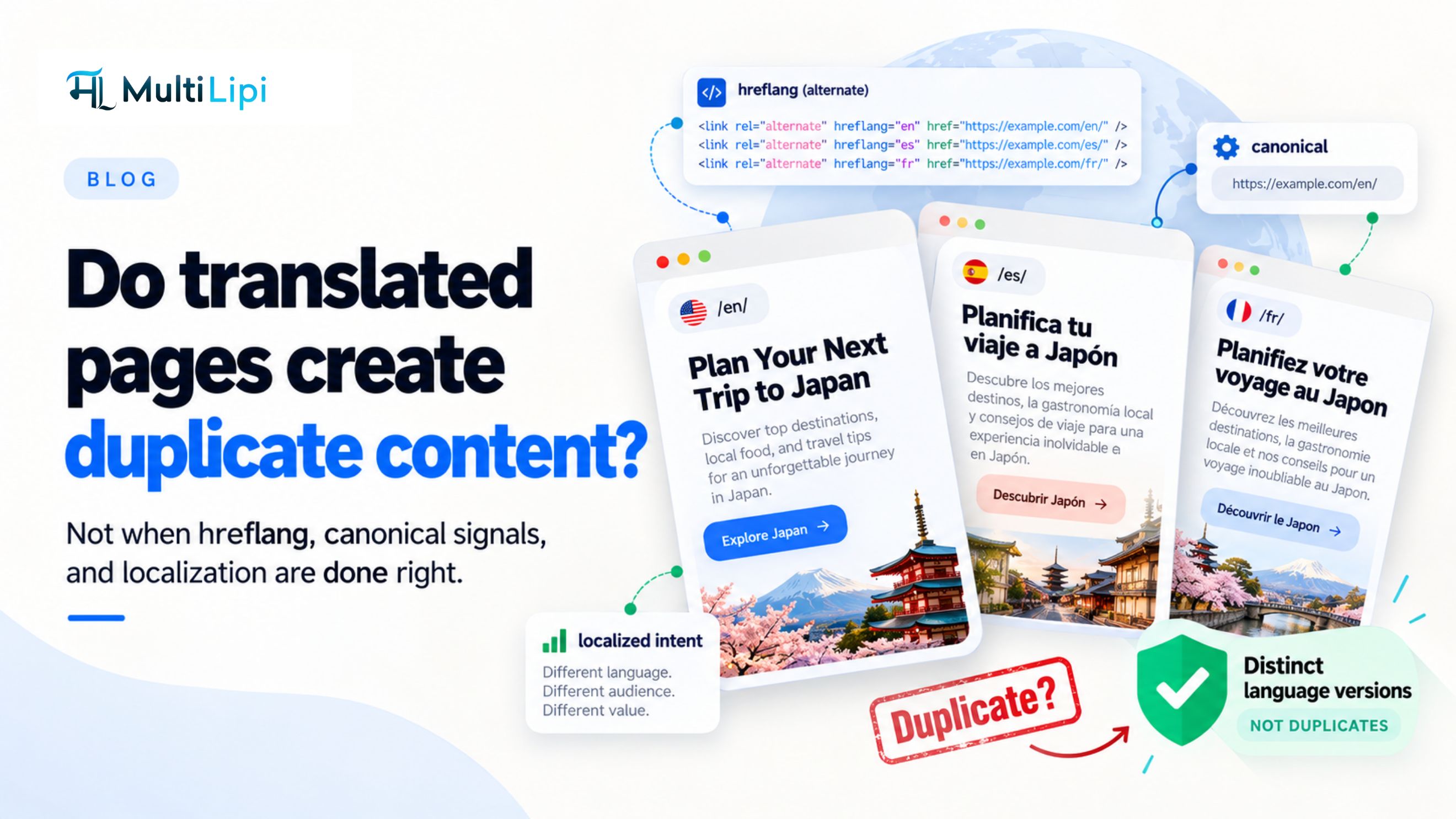
Hreflang tags tell Google search which version of a page fits which language and region. They were designed for classic ranking, not for AI-written answers.
The job is narrow. When several versions of a page exist, hreflang helps the engine show the right one to the right searcher. It works at the level of the results page, where one URL replaces another.
A typical setup covers cases like these:
Each version points to the others, and each one points back. That reciprocal link is what makes the annotation valid, whichever of the three hreflang implementation methods you use. In HTML, you place link tags in the head of every page. In an XML sitemap, you list each alternate URL inside the entry for its page. With HTTP headers, you send the annotations in the response itself, which suits non-HTML files such as PDFs. The method matters less than consistency, because every version must still return the full set of references.
If one page lists a sibling but the sibling does not return the reference, the engine can ignore the pair. Missing return links are among the most common hreflang errors, and they are often joined by two others: self-references left out of the annotation set, and invalid language or region codes such as "en-UK" instead of "en-GB". These mistakes can cause Google to ignore particular annotations or return-link pairs, which is why hreflang may appear ineffective.
Hreflang is a hint, not a command. The engine can still choose a different version if other signals pull harder.
Those other signals include the language of the visible content, the location of the searcher, and which version attracts links or engagement. If your regional pages are near duplicates, the engine may treat them as one page and pick a single version for everyone.
Consider a brand with English pages for two countries that differ only in a price symbol. The engine sees almost identical text. It may fold them together, and the hreflang hint has little to work with.
This is why real differences matter. Local pricing, local legal wording, local shipping terms and local contact details give each version a reason to exist. Tools such as MultiLipi can help you manage translated and regional versions so each one stays consistent and clearly separate.
Where x-default fits
The x-default value marks a fallback page. It serves searchers whose language or region matches none of your listed versions.
Many sites point it at a language selector or a global homepage. You decide which page works best as the catch-all.
Choose with the visitor in mind. A searcher from an unlisted market should land somewhere useful, not on a dead end or a page written for one country only.
Keep this in mind: hreflang swaps URLs in results. It does not rank a page higher or rewrite its content. That limit matters when you ask whether AI answers respect it.
An AI answer builds a response from many sources. It may never display a URL swap at all, so a tag built for swapping results cannot guarantee which market's page gets cited.
How AI Answers Choose Among Regional Versions
FROM PROMPT TO REGIONAL REFERENCE
Retrieval first, language second
An AI answer starts with retrieval. The system pulls pages that match the query, then writes a response from what it found.
Language and region may also shape retrieval itself. If your French page is not available to the retrieval system, a hreflang annotation alone cannot make the answer cite it.
ChatGPT, Gemini, Copilot, Claude, and Perplexity use different retrieval and search approaches; the exact way each chooses available regional URLs is not fully public.
That order of operations changes where you should spend effort. Before you tune regional signals, confirm that each market's page is crawlable, indexable, and relevant to the query in the language the user types.
Consider a brand with near identical English pages for the US and the UK. If the index treats them as duplicates and keeps one, the answer can only cite that one, whatever the user's location.
What testing across AI search platforms has shown
The testing by Glenn Gabe, which drew coverage in industry discussion like that on Search Engine Roundtable, started with ChatGPT.
Other practitioners compared translated and untranslated Spanish and English sites in Spain and Mexico. The goal was to see which version surfaced for multilingual queries.
Take these results as signals, not rules. Small tests do not prove how every platform behaves.
What they do show is that translation quality and completeness matter to retrieval. A page that is only partly translated gives the system mixed language signals, which makes it harder to match to a query in one language.
This is where a platform like MultiLipi can help. Consistent, fully translated pages with clear language and market differences give the index something distinct to retrieve for each audience.
Why the evidence on hreflang is still inference
The claim that AI models default to the most authoritative version without correct hreflang is plausible, but it is an interpretation. The opposing view is more careful: there is currently no evidence that the model applies a regional preference based on hreflang.
Here is the practical reading for your international SEO work:
So keep your hreflang clean, but do not rely on it alone. Whether hreflang is still necessary now that AI systems can detect language on their own is a fair question, and the answer is yes, though for a narrower reason than before. Its impact on AI search citation accuracy is likely indirect, working through the index rather than the model. Correct hreflang annotations help search engines pair each query with the right regional version of a page, so the sources an AI answer draws from are more likely to match the user's language and market. Language detection can tell what language a query or page is written in, but it cannot tell which of several near-identical pages, such as English for the US, UK, or Australia, was meant for a given market, and hreflang can help search engines understand those regional relationships. There is no public confirmation that the answer-generating model directly uses those tags to select citations, which means a broken setup can still lead to the wrong version being cited, while a clean one only improves the odds.
The safer move is to make each regional page genuinely different in substance: local pricing context, local terminology, local examples. Hreflang tags help search engines map variants to the right audience, but it is not established whether or how systems like ChatGPT and Perplexity use these annotations when retrieving and citing passages, so near-duplicate pages can blur together or surface in the wrong market. Distinct pages give retrieval a reason to pick the right market, and the hreflang signals then reinforce a choice the content already makes.
Expert Insight
"TBH hreflang is one of the most complex aspects of SEO (if not the most complex one). Feels as easy as a meta-tag, but it gets really hard quickly." , John Mueller, Google
Signals That May Influence Which Market Gets Cited
SEPARATE EVIDENCE FROM INFERENCE
Alternate regional URLs can help Google select appropriate pages.
Track citations using repeatable prompts in each market.
Avoid claims that a tag guarantees a market-specific citation.
Once retrieval has done its work, a handful of signals shape which regional version an AI answer cites. Some are well documented. Others are educated guesses, and we flag which is which.
Query language and user location
The language of the prompt is the strongest visible cue. A query written in French tends to pull French pages, and a query in English tends to pull English ones.
This works because the model matches the language of the question to the language of the source. If your French page is thin or missing, the answer may cite an English page and translate it on the fly. You lose the citation, and the user sees your brand through a version you did not write for them.
Location may add a second layer, and it is where wrong-language URL citations in AI answers often begin. Google AI Overviews and AI Mode sit on top of Google search, which already uses searcher location, so language URL selection in these features starts from the same signals that decide which version of a page ranks. This is where hreflang and AI Overviews regional results in Google meet: when an Overview or an AI Mode answer cites a source, it usually picks the URL whose language matches the query and the searcher's location, and hreflang annotations help it choose the right regional or language version instead of a mismatched one. For a French-language query in Canada, a localized fr-CA page may be relevant, but its appearance in an AI citation is not guaranteed by complete and reciprocal annotations. Copilot can draw on web retrieval too, but its treatment of hreflang and location signals is not documented to the same degree as Google Search. Compare its citations empirically rather than assuming it applies Google’s rules. This uncertainty is one possible explanation for a French-speaking user seeing an English-language citation even when a French version exists. Hreflang still helps in both ecosystems, but it works as a hint rather than a rule, and regional results in Google AI Overviews can still surface the wrong version when your annotations conflict with the content on the page, point to redirected URLs, or lack return tags. Fixing wrong-language citations means making sure hreflang tags, on-page language, and country signals all point to the same version of each page.
That matters when two markets share a language. A searcher in Canada and a searcher in Australia may both type in English, but the underlying search layer can still tilt results toward pages that fit their region.
Whether ChatGPT, Claude, or Perplexity weigh location the same way is not established, and the same uncertainty applies to hreflang support in ChatGPT, Perplexity, and Claude. The same goes for how crawlers such as GPTBot and PerplexityBot process hreflang annotations: they may fetch every regional version of a page without treating the tags as instructions to group those versions or pick one for a given user. None of these companies has confirmed that its crawler or retrieval system reads hreflang to choose between regional versions, so a tag that guides Google may have no effect on which version these tools index or cite. A crawler could ignore the annotations, record them as plain markup, or use them only to discover alternate URLs, and nothing public says which. Treat it as a possibility, not a rule.
Canonical tags and duplicate clustering
Search engines group near-identical pages into clusters and pick one representative. If your United States and other English pages are almost the same, one may absorb the rest.
The cluster winner is what the AI layer is likely to see. A regional page folded into another may never reach the answer, because LLMs cannot tell which location or entity it was meant to describe. Regional disambiguation and entity clarity for LLMs depend on distinct signals: a clear place name, a consistent entity description, and a page that stands apart from its neighbors. Without them, the model treats two regional pages as one entity, and that may concentrate citations on one version.
Canonical tags can make this worse. Pointing every regional page to one canonical tells the engine to ignore your local versions.
Audit your canonicals before anything else, and use them as the starting point for auditing AI citations of regional pages. Each regional page should normally point to itself, so the engine treats it as a legitimate version rather than a copy. Once that is in place, check which regional URLs AI answers actually cite. If they keep surfacing a single national page or the wrong market’s version, a canonical conflict is one possibility to investigate alongside content relevance and crawlability.
Authority concentrating on one version
When regional signals are unclear, authority may decide the outcome. That remains an inference, not a confirmed rule.
Authority can pile up on one page in several ways:
When that happens, the strongest page may be cited for every market, even where it fits poorly.
Consider a brand whose German page is a light translation of the main site. Every outside reference goes to the original, so the German page has nothing to stand on. A model choosing a source for a German question sees one strong page and one weak copy.
A platform such as MultiLipi can help keep regional versions consistent and properly structured. The local substance still has to come from you: market-specific details, local proof, and wording that reflects how people in that region actually ask.
Where Hreflang Falls Short in AI-Mediated Search
SAME BRAND • DIFFERENT REGIONAL CONTEXT
Even the strongest signals have limits. Hreflang is useful, but it was not built for the way AI answers are assembled.
Retrieval layers that ignore annotations
Google Search documentation describes hreflang as a way to serve the right URL to the right searcher. AI answers add steps that the documentation never covered.
Hreflang URL discovery and indexing for AI crawlers is far from guaranteed, and pairing hreflang with llms.txt does not change that on its own. Some retrieval layers may fetch pages without reading link annotations at all, so alternate-language URLs never get discovered and never reach the index. Whether GPTBot or PerplexityBot can reach those alternates at all depends on robots.txt rules and server settings, and a regional version blocked to either crawler is invisible no matter how clean the tags are. An optional llms.txt file might list language variants, but there is no general guarantee that AI crawlers consume it; crawlable HTML links and sitemaps remain important discovery paths. Others may pull passages instead of whole URLs, so the hreflang signal has nothing to attach to and the right regional version cannot be matched to the right user.
In practice, a passage is lifted from a page, scored on its own, and quoted. The market context that hreflang carries stays behind with the full URL.
That leaves gaps you cannot see from outside:
The merged reply is the riskiest case. A shipping policy from one market can sit next to a price from another, and the user sees one confident answer.
Hreflang tags still help the search index. They just do not guarantee anything about the final answer.
This is why the page itself must carry market clues. Currency, local contact details, regional terms and legal wording stay attached to a passage even when the annotations do not. If you manage many language versions, a translation platform such as MultiLipi can help keep those local details consistent across markets.
Canonical and hreflang conflicts
One of the sharper criticisms of hreflang in AI-mediated search is the unresolved tension between rel="canonical" and internationalization. The two signals can pull in opposite directions.
Canonical says: treat this page as the main copy. Hreflang says: this page has a sibling for another market.
When they clash, the engine usually trusts the canonical. Your regional page then drops out of the cluster.
Here is a typical scenario of a hreflang validation error. A German page canonicalizes to the English original, but its hreflang tags still list it as the German version. That is a canonical conflict: the page tells crawlers it is a duplicate and a distinct alternate at the same time. The index follows the canonical, treats the German page as a duplicate, and drops the hreflang annotation. Missing return tags make it worse. If the English page does not point back to the German URL, the pair is unconfirmed and the cluster is ignored. The German URL may lose visibility as a separate indexed variant, reducing the opportunity for search-based AI systems to cite its localized content.
Check for these common conflicts:
The third conflict is easy to miss. When two English pages differ only by a flag or a footer, the engine sees duplicates and picks one.
Fix these first. No amount of extra markup helps a page the index has already folded away.
A Practical Audit for Regional AI Citations
Use a repeatable process to find the gap between localized pages that exist and URLs that actually surface in AI answers.
Open each localized page directly and confirm crawlable, indexable content.
Check return links, self-references, language codes, and absolute URLs.
Identify cross-locale canonical conflicts and near-duplicate pages.
Use market pricing, legal context, shipping, contact details, and terminology.
Run the same prompts across relevant languages, regions, and AI products.
Record the URL cited, response accuracy, and configuration changes over time.
Frequently Asked Questions
Does hreflang directly determine which URL ChatGPT cites?
No direct, universal influence is publicly established. It is useful for international search engines; AI retrieval and citation behavior should be tested separately.
Should each regional page have a self-referencing canonical?
In most multilingual setups, a distinct indexable regional URL should ordinarily have an appropriate canonical to itself, rather than automatically pointing to a different language or market.
Can near-identical pages for different countries both be useful?
Yes. Google supports region-specific alternate pages, but meaningful regional details improve usefulness. Keep the relationship clear through hreflang and canonical signals.
Does adding llms.txt guarantee regional citations?
No. There is no broad guarantee that AI services consume llms.txt, and Google says it is not required for its AI search experiences.
What should a multilingual AI citation audit measure?
Check the language and region of the prompt, the URL cited, whether it is the intended locale, the answer’s factual accuracy, and the technical state of the localized URL.
Conclusion
Hreflang remains valuable for matching languages and regions in Google Search, but it cannot guarantee which regional URL an AI-generated answer cites. The most reliable strategy combines valid international SEO annotations, coherent canonicals, genuinely useful local details, and real-world monitoring of AI citations.
Explore Related MultiLipi Resources
Use these guides and checks to strengthen regional discovery, multilingual SEO, and AI-search readiness.